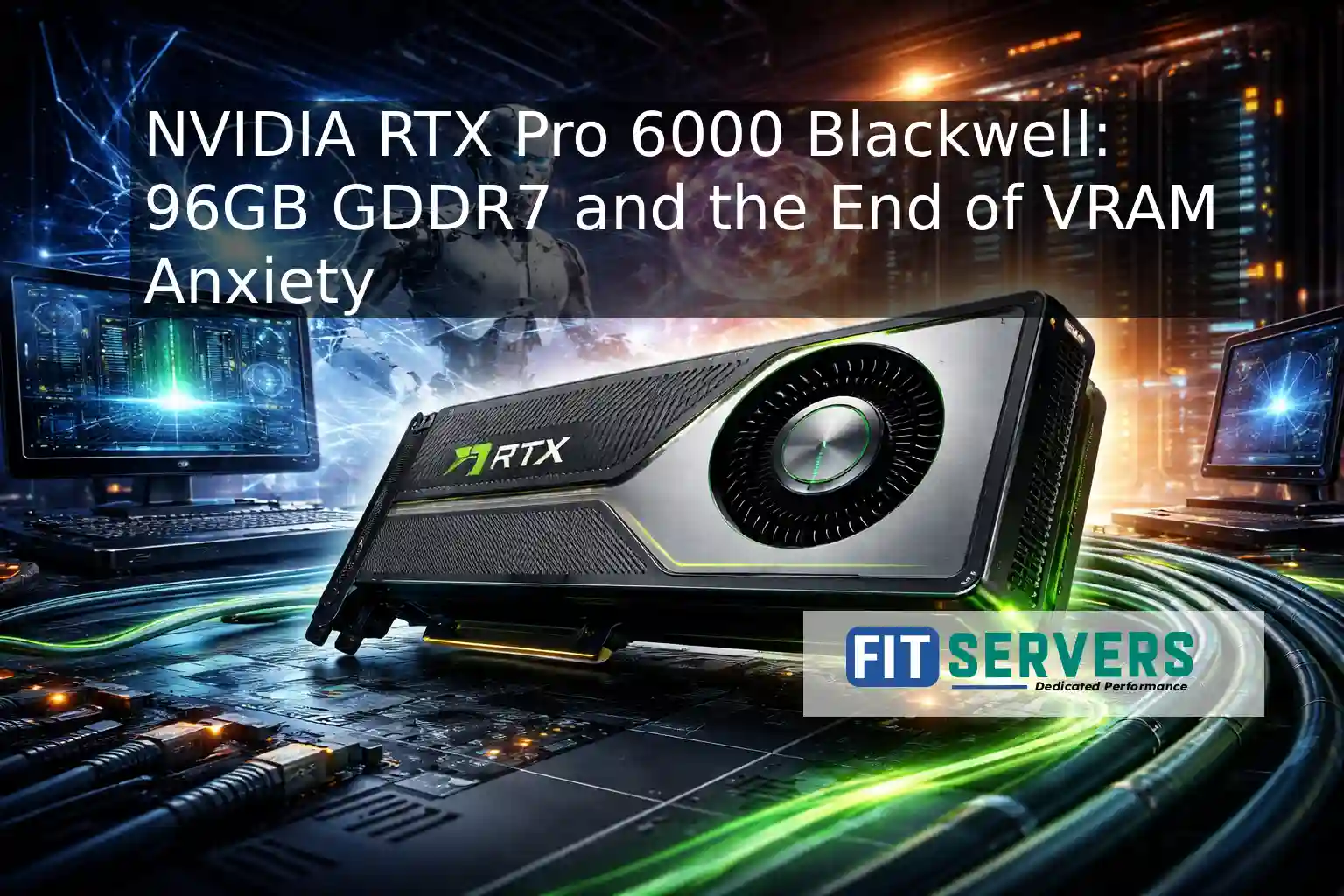
NVIDIA RTX Pro 6000 Blackwell: 96GB GDDR7 and the End of VRAM Anxiety
The most powerful professional workstation GPU ever built packs 24,064 CUDA cores, fifth-generation Tensor Cores with native FP4 support, and double the memory of its predecessor — all on a single card. Here's what it means for AI inference, local LLMs, and production rendering workflows.
Announced at NVIDIA GTC in March 2025 and shipping from April 2025 via PNY and TD SYNNEX, the card is built on the GB202 Blackwell die — the same silicon used in the consumer RTX 5090. The PRO 6000 variation runs 24,064 CUDA cores (slightly below the die's 24,576 maximum), and doubles the memory of its predecessor from 48 GB GDDR6 on the Ada generation to 96 GB GDDR7. It also doubles the TDP from 300W to 600W, making power and airflow serious planning considerations.
Key context: The previous generation RTX 6000 Ada topped out at 48 GB GDDR6. The new RTX Pro 6000 Blackwell doubles VRAM capacity, nearly doubles memory bandwidth, and adds native FP4 compute support — a first for workstation-class GPUs.
Full Technical Specifications
| Specification | RTX Pro 6000 Blackwell | RTX 6000 Ada (Prev. Gen) |
|---|---|---|
| GPU Die | GB202 (Blackwell) | AD102 (Ada Lovelace) |
| CUDA Cores | 24,064 | 18,176 |
| Tensor Cores | 752 (5th Gen) | 568 (4th Gen) |
| RT Cores | 188 (4th Gen) | 142 (3rd Gen) |
| Memory Capacity | 96 GB GDDR7 ECC | 48 GB GDDR6 ECC |
| Memory Bandwidth | 1,792 GB/s | ~960 GB/s |
| Memory Bus Width | 512-bit | 384-bit |
| FP32 Performance | 125 TFLOPS | ~91 TFLOPS |
| FP4 (AI Inference) | 3.8 PFLOPS (native) | Not supported |
| Base / Boost Clock | 1,590 / 2,617 MHz | ~900 / 2,505 MHz |
| TDP (Workstation Ed.) | 600 W max | 300 W |
| TDP (Max-Q Ed.) | 300 W | 300 W |
| Form Factor | Dual-slot, full tower | Dual-slot |
| Cooling (WE) | Double flow-through | Blower |
| PCIe Interface | Gen 5 x16 | Gen 4 x16 |
| Display Outputs | 4× DisplayPort 2.1b | 4× DP 1.4 |
| NVLink Support | NVLink Gen 5 (WE/Server) | NVLink (limited) |
| MIG Support | Yes (Universal MIG) | No |
| MSRP (at launch) | ~$8,565 | ~$3,500–$4,000 |
| Release Date | March 18, 2025 | 2022 |
| Warranty | 3 years (OEM) | 3 years |
Blackwell Architecture: What's New
Fifth-Generation Tensor Cores with Native FP4
The most significant AI-specific advancement in Blackwell is native FP4 (4-bit floating point) support in the 5th-generation Tensor Cores. NVIDIA claims these deliver up to 3× the performance of the previous generation. For LLM inference specifically, FP4 precision (NVFP4) allows the GPU to process more tokens per second with minimal accuracy degradation compared to FP16 or BF16. Real-world benchmarks confirm this: in independent testing on Akamai Cloud, FP4 delivers a 1.32× improvement in throughput over FP8 on the same GPU, and at the hardware level, Blackwell's 5th-generation Tensor Cores natively support FP4/FP6/FP8, allowing FP4 workloads to fully utilize low-precision compute and bandwidth efficiency.
Fourth-Generation RT Cores: 2× Ray Triangle Rate
Fourth-generation RT Cores deliver up to 2× the performance of the previous generation, accelerating rendering for media and entertainment content creation, architecture and engineering workflows, and manufacturing prototyping. The practical outcome for production rendering is what NVIDIA calls RTX Mega Geometry — a technique that enables up to 100× more ray-traced triangles compared to standard rendering paths. This matters for scenes with extreme geometric complexity like VFX, automotive design, and large-scale architectural visualization.
Universal MIG (Multi-Instance GPU)
The RTX Pro 6000 Blackwell introduces Universal MIG to the workstation GPU class for the first time. This divides a single RTX Pro 6000 Blackwell into multiple isolated instances, each with dedicated resources, allowing for concurrent execution of multiple workloads, optimized GPU utilization, and secure isolation of different applications or users. For organizations sharing a single workstation among multiple users or projects — or for hosting providers running multi-tenant inference — MIG eliminates the need for separate GPU allocations.
PCIe Gen 5 and Memory Bandwidth
PCIe Gen 5 support provides double the bandwidth of PCIe Gen 4, improving data-transfer speeds from CPU memory and unlocking faster performance for data-intensive tasks like AI, data science, and 3D modeling. The 512-bit memory bus combined with GDDR7 modules on both sides of the PCB delivers a measured 1,792 GB/s memory bandwidth — nearly double the bandwidth of the Ada generation.
96 GB GDDR7: Why Memory Capacity Is the Whole Story
The core value proposition of this GPU is not its compute throughput — it's the memory. For AI and rendering professionals, VRAM capacity is the hard ceiling that determines what you can actually do on a single machine. Here's what 96 GB enables that 48 GB or 24 GB cannot:
The Llama-3 70B benchmark: 96 GB of VRAM allows researchers to fit massive models like Llama-3 70B entirely on a single card with room for high context windows — a workload that previously required either two consumer GPUs with shared VRAM or a $30,000+ H100 card.
AI Inference Benchmarks: Real-World Results
LLM Throughput vs. Previous Generation (L40S)
The RTX Pro 6000 Blackwell Server Edition achieves up to 5.6× faster LLM inference compared to the previous NVIDIA L40S generation, and 3.5× faster text-to-video generation.
Single-GPU LLM Throughput vs. H100
For single-GPU workloads, the RTX Pro 6000 with GDDR7 memory outperforms even the H100 SXM with its HBM3e in single-GPU throughput at 3,140 vs 2,987 tokens per second, while delivering 28% lower cost per token ($0.18 vs $0.25 per million tokens).
The RTX Pro 6000 beating the H100 SXM in single-GPU LLM throughput is a striking result. It is explained by Blackwell's native FP4 hardware path: the H100 was built before FP4 was defined as a production precision, so its inference advantage is limited to FP8 and BF16. The RTX Pro 6000's 5th-gen Tensor Cores exploit FP4 natively, yielding higher throughput per watt for quantized models.
Where H100 Still Wins: Multi-GPU and Training
The H100's advantage re-emerges at scale. For large models requiring 8-way tensor parallelism, datacenter GPUs pull ahead significantly — the H100 and H200's NVLink interconnect delivers 3–4× the throughput of PCIe-bound RTX Pro 6000s. The RTX Pro 6000 also lacks the H100's Transformer Engine and HBM memory, which give the H100 a clear advantage for model training and fine-tuning at scale.
The PCIe ceiling: Multi-GPU RTX Pro 6000 setups communicate over PCIe rather than NVLink (unless using NVLink Gen 5 on Workstation/Server Edition with special cabling). For inference workloads requiring 2–8 GPUs on very large models, the inter-GPU bandwidth becomes a bottleneck that H100/H200 NVLink clusters do not face.
Akamai Cloud LLM Benchmark (FP8 vs FP4)
At consistent concurrency levels, the RTX Pro 6000 Blackwell Server achieved 3,030 tokens per second for the Llama-3.3-Nemotron-Super-49B model, with FP4 delivering a 1.32× throughput improvement over FP8. This validates real-world production numbers, not theoretical peaks.
Rendering Workflows: What Studios Get
For 3D rendering, VFX, and architectural visualization, the RTX Pro 6000 Blackwell's improvements are substantial but different in character than the AI gains.
AI-Assisted Rendering (DLSS 4 + Neural Graphics)
RTX neural shaders leverage AI to automate complex lighting and texture generation, while DLSS 4 enhances performance and visual fidelity through AI-powered upscaling, enabling real-time photorealistic rendering. DLSS 4 Multi Frame Generation — which can generate up to three additional frames per rendered frame — is supported for the first time on a professional workstation GPU with this card.
Ray Tracing Performance
The 4th-generation RT Cores with a 2× ray-triangle intersection rate over the previous generation enable meaningfully more complex scenes to be ray-traced interactively. RTX Mega Geometry enables up to 100× more ray-traced triangles in physically accurate scenes and immersive 3D designs. For Unreal Engine, Blender Cycles, Autodesk VRED, and Chaos V-Ray users, this translates to fewer geometry instances needing to be baked or approximated before interactive rendering is usable.
Rendering Benchmark: vs. Ada Generation
RTX Pro 6000 vs. Alternatives: Which Card for Which Buyer
The RTX 5090 and RTX Pro 6000 Blackwell are built on the same GB202 die, making the Pro 6000's price premium entirely about memory capacity, ECC reliability, professional driver support, MIG, and the workstation warranty. The PRO 6000 has 24,064 CUDA cores to the 21,760 of the 5090 — nearly an 11% increase — and in gaming benchmarks the Pro 6000 outperformed the 5090 by roughly 5 to 14%. But the 3× price difference is not justified by compute performance alone. It is justified by the memory capacity and the use cases that only 96 GB enables.
600W: The Elephant in the Rack
Where past top-end cards have tended to max out around 300W, the flagship RTX Pro 6000 Blackwell Edition specs an eye-watering 600W design power. This card clearly isn't meant for all applications, nor all machines. Only big, fixed workstations with heavy-duty power supplies and cooling subsystems need apply.
Specifically, the GPU requires 4× 150W auxiliary GPU power cables, channeled through NVIDIA's more recent auxiliary power connector with a 4× 8-pin pigtail adapter. And "big" isn't something to be taken lightly — anything but a full-size tower won't provide adequate clearance. Dell's redesigned Pro Max T2 Tower is one confirmed workstation designed to accommodate this GPU's physical and power requirements.
Max-Q Edition: 300W for Smaller Deployments
For users who need the 96 GB GDDR7 but cannot accommodate a 600W GPU, the RTX Pro 6000 Blackwell Max-Q Workstation Edition offers the same memory capacity at a 300W TDP — matching the previous generation's power envelope. Performance is somewhat reduced, but it fits the power and thermal budgets of a much wider range of existing workstations. This is NVIDIA repurposing the "Max-Q" term — previously used for mobile GPUs — to denote maximum efficiency rather than maximum performance in a desktop context.
Server Edition: Passive Cooling for Rack Deployment
The RTX Pro 6000 Blackwell Server Edition is a fully passive, fanless card designed for rack servers with front-to-back forced airflow. It has no display outputs. Firmware, power, and thermal profiles are tuned for 24×7 duty under a scheduler, typically paired with NVIDIA AI Enterprise, container orchestration, and hypervisor passthrough. This is the version deployed in cloud environments like CoreWeave, Akamai, and Vast.AI for GPU rental.
Three Editions: Which One is Right for You
| Edition | TDP | Cooling | Best For |
|---|---|---|---|
| Workstation Edition (WE) | 600W | Double flow-through, active | Full-size tower workstations; maximum performance |
| Max-Q Workstation Edition | 300W | Standard blower, active | Mainstream towers; power-constrained environments |
| Server Edition | 600W | Fully passive (rack airflow) | Rack servers, data centers, cloud inference nodes |
Who Should Buy This Card (and Who Should Not)
Strong buy for:
- ✓ AI researchers and developers running 70B+ models locally without cloud dependency
- ✓ VFX studios and architectural firms with complex production scenes exceeding 40 GB of VRAM
- ✓ Multi-tenant environments using MIG to partition a single GPU for isolated workloads
- ✓ Organizations replacing aging A100 or H100 inference nodes at substantially lower cost per token
- ✓ Simulation engineers running CFD, molecular dynamics, or genomics pipelines on-premise
Skip it if:
- ✕ Your models fit in 32 GB — an RTX 5090 costs 70% less and is 90%+ as fast on compute
- ✕ You need multi-GPU tensor parallelism for 200B+ models — NVLink H100 clusters remain superior
- ✕ Your workstation chassis is mid-tower or smaller — the 600W Workstation Edition requires full-size towers
- ✕ Your primary workload is model training at scale — the H100's Transformer Engine and HBM remain better suited for that specific task
Pricing and Availability (April 2026)
The MSRP was set at approximately $8,565 upon its release in March 2025. As of March 2026, retail prices typically range between $8,000 and $9,200 through authorized partners, with refurbished units in the $7,800–$8,200 range. The card is available through PNY and TD SYNNEX distribution channels, and is included in workstation configurations from Dell, HP, and Lenovo announced at GTC 2026.
For cloud-based access, the GPU is available on multiple platforms: rental pricing ranges from approximately $1.00/hr on Vast.ai to $2.85/hr on Google Cloud and $3.36/hr on AWS as of early 2026.
Cost-per-token context: At $8,500 hardware cost and running 24/7, a single RTX Pro 6000 Blackwell amortizes over 3 years to roughly $0.30/hour in hardware cost — making the cost-per-token for on-premise inference highly competitive with cloud GPU rental for sustained high-utilization deployments.
🏆 Verdict
The RTX Pro 6000 Blackwell is the right GPU if and only if your bottleneck is VRAM. Its 96 GB GDDR7 at 1.8 TB/s is an unprecedented combination for a workstation card, and the native FP4 inference path makes it surprisingly competitive with data center hardware at a fraction of the cost for single-GPU workloads.
The 600W Workstation Edition is genuinely demanding on infrastructure — it requires a full-size tower, heavy power supply, and careful airflow planning. The Max-Q edition at 300W removes those constraints while keeping the full 96 GB capacity, at the cost of some compute throughput.
For studios and labs that have been waiting for a single card that could handle both large-scale production rendering and local AI model deployment without compromise, the wait is over. The RTX Pro 6000 Blackwell makes that combination a workstation-class purchase rather than a data center project.
Ready to Upgrade?
Purchase or configure custom deployments featuring the NVIDIA RTX Pro 6000 Blackwell today.
Purchase using Fit Servers Dedicated Server Finder