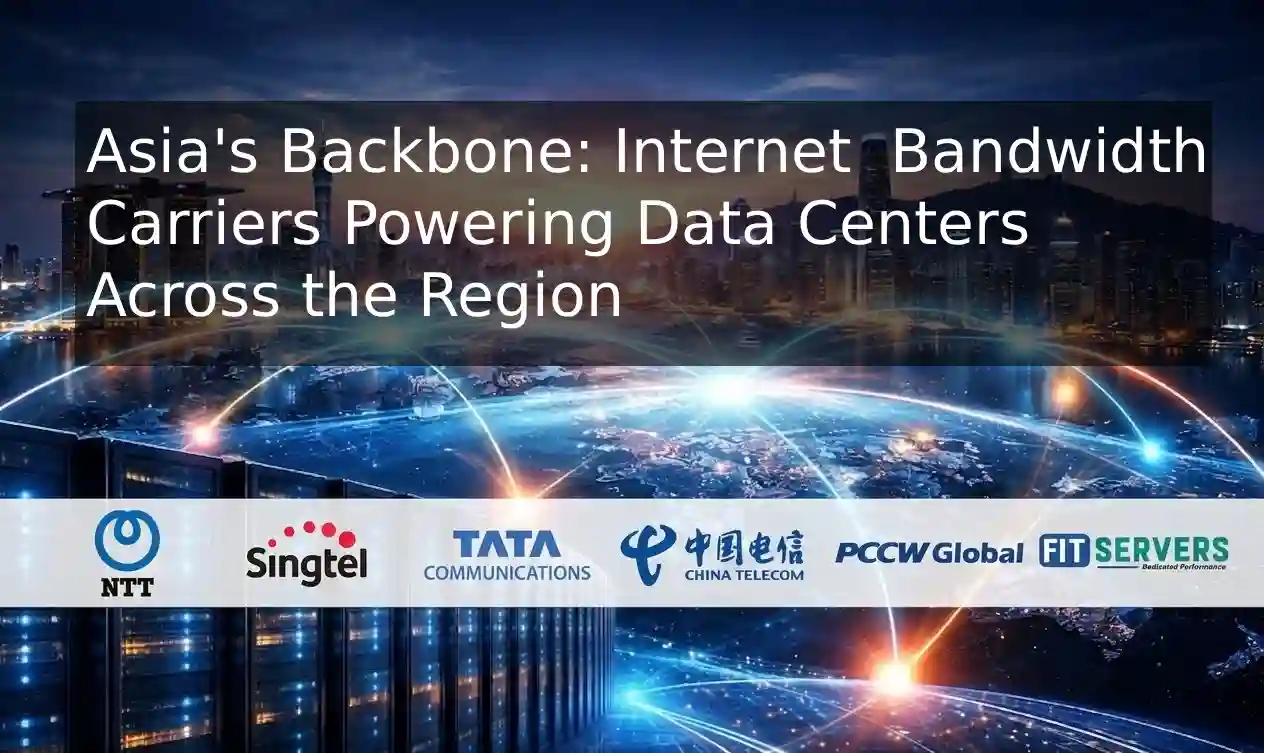
Asia's Backbone: Internet Bandwidth Carriers Powering Data Centers Across the Region
A complete guide to the Tier 1 and Tier 2 network carriers driving internet connectivity across Asia — and why Fit Servers delivers industry-leading low latency across every major Asian market.
Asia is the world's fastest-growing internet market. With over 2.8 billion internet users across the continent, and data center capacity expanding at unprecedented speed in hubs like Singapore, Tokyo, Hong Kong, Mumbai, and Seoul — choosing the right network carrier is one of the most critical infrastructure decisions a business can make. This guide breaks down who the major bandwidth providers are, what they offer, how they differ, and how Fit Servers leverages the best of them to keep latency remarkably low across the entire region.
Why Internet Backbone Carriers Matter for Data Centers
When businesses deploy servers in an Asian data center, they are not simply renting rack space. They are buying into a complex, layered network ecosystem — and the quality of that ecosystem determines everything from page load speeds to real-time trading performance to video conferencing quality.
At the heart of this ecosystem are internet backbone carriers, sometimes called Tier 1 or Tier 2 ISPs (Internet Service Providers). These are the organizations that own and operate the physical fiber-optic cables, submarine cable landing stations, internet exchange points (IXPs), and peering agreements that carry internet traffic across Asia and to the rest of the world.
Key insight: The latency, redundancy, and peering capacity of your hosting provider is determined less by the data center building itself and more by the combination of backbone carriers operating within it. This is why understanding Asia's carrier landscape is essential.
Tier 1 vs Tier 2: A Tier 1 network can reach every other network on the internet exclusively through settlement-free peering. A Tier 2 network peers freely with some networks, but still purchases transit from Tier 1 carriers to reach all corners of the internet. Both matter: Tier 1 carriers provide the global backbone, while Tier 2 carriers often provide the lowest-latency paths to local end users within a country.
Global Tier 1 Carriers Active in Asia
Before examining Asia-specific providers, it is important to understand the major global Tier 1 carriers that form the international dimension of Asia's internet infrastructure.
NTT Communications
Japan · Global Tier 1Operates one of the most extensive global IP networks (AS2914), with dense presence throughout Asia-Pacific. Known for premium latency performance and a massive submarine cable portfolio.
Lumen Technologies
USA · Global Tier 1Maintains a significant backbone presence in Asian markets, particularly connecting Asia to North America with low-latency paths for enterprise customers.
Cogent Communications
USA · Global Tier 1A value-oriented Tier 1 with growing PoP density in major Asian data centers. Frequently chosen for cost-effective global transit with solid intercontinental routing.
Arelion
Sweden · Global Tier 1Owns a highly connected global backbone with significant presence in Singapore, Tokyo, and Hong Kong. Highly regarded for routing quality.
Tata Communications
India · Global Tier 1Operates the world's largest wholly owned submarine cable network. One of the few Asian-headquartered Tier 1 operators globally.
Hurricane Electric
USA · Global Tier 1Renowned for having the most peers of any network. Maintains highly efficient routing across Asia through its global IXP presence.
Asia's Major Regional Bandwidth Carriers
NTT Communications — Japan's Global Network Giant
Within Asia, NTT operates one of the densest concentrations of PoPs — in Tokyo, Osaka, Singapore, Hong Kong, Seoul, and across China, India, and Southeast Asia. For data centers in Japan, NTT's network is the benchmark for ultra-low latency.
Singtel — Southeast Asia's Connectivity Cornerstone
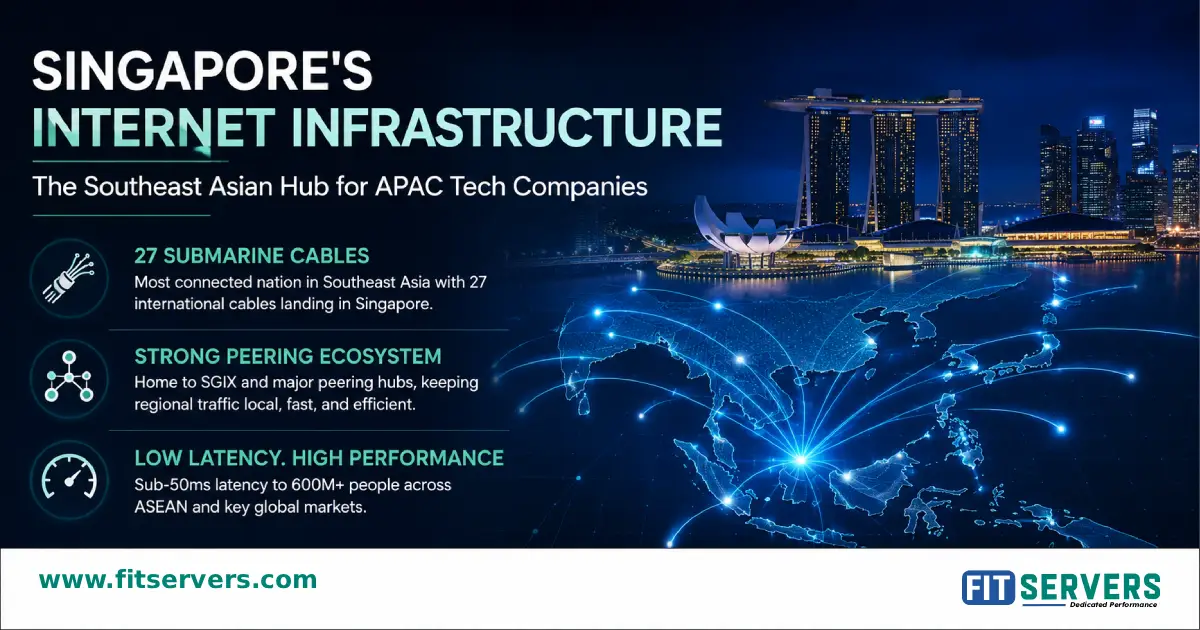
Singtel operates a vast submarine cable network with stakes in over 30 international cables. From a semantic network proximity standpoint, Singtel is the thread that ties together the ASEAN internet: Thailand, Malaysia, Indonesia, Vietnam, the Philippines, and Myanmar all route significant traffic through Singtel.
Tata Communications & Bharti Airtel — India and Beyond
Tata operates the world's largest private undersea cable network and a comprehensive national backbone in India. Bharti Airtel operates a dense domestic Indian network and 4G/5G coverage, making it valuable for traffic terminating at Indian mobile devices.
Why India routing is uniquely complex
India operates under a domestic carrier licensing regime that means foreign carriers cannot own domestic infrastructure. Data centers hosting Indian-facing workloads need to ensure their bandwidth carriers have robust domestic peering arrangements — not just good international backbones.
China Telecom & China Unicom
China Telecom's CN2 GIA (Global Internet Access) is widely considered the gold standard for China-bound routing, engineered to minimize packet loss at the China border. China Unicom offers the ChinaNet-backbone and the higher-quality China169 network.
PCCW Global — Hong Kong's Strategic Transit Hub
PCCW Global leverages Hong Kong's geography to build a global carrier network. For businesses needing to serve both Chinese-mainland and international audiences, Hong Kong-based PCCW connectivity is frequently the optimal architecture.
Asia's Major Carriers at a Glance
| Carrier | HQ / Hub | Tier | Best For |
|---|---|---|---|
| NTT Communications | Tokyo, Japan | Tier 1 Global | Japan, Asia-Pacific, global enterprise |
| Singtel | Singapore | Tier 1 Regional | ASEAN region, Singapore hub traffic |
| Tata Communications | Mumbai, India | Tier 1 Global | India, Middle East, Europe links |
| Bharti Airtel | New Delhi, India | Tier 1 Regional | Indian domestic audience, mobile traffic |
| China Telecom (CN2) | Beijing, China | State-tier | Mainland China traffic, gaming, fintech |
| PCCW Global | Hong Kong | Tier 1 Regional | China + international dual-audiences |
Fit Servers: Ultra-Low Latency Across the Asian Region
The Fit Servers network advantage is built on interconnected engineering principles:
- Multi-carrier redundancy: Every Fit Servers location maintains connectivity from multiple Tier 1 and Tier 2 carriers. Traffic intelligently shifts to the optimal alternative path if one carrier experiences congestion.
- IXP participation: We actively participate in major Asian internet exchange points, eliminating unnecessary transit hops.
- Strategic PoP placement: Co-located within carrier-neutral facilities to leverage maximum carrier selection without expensive cross-connects.
- BGP traffic engineering: Our NOC continuously monitors BGP routing tables to ensure packets take the least-congested path.
"Fit Servers' latency performance across the Asian region is not accidental — it is the result of deliberate, continuous network engineering optimized for the unique topology of Asia's internet infrastructure."
The Carrier-Neutral Advantage
A carrier-neutral data center does not have an exclusive relationship with any single bandwidth provider. Instead, multiple competing carriers are permitted to install equipment. Fit Servers operates exclusively within carrier-neutral facilities in its Asian locations. This ensures that our bandwidth strategy can evolve, adding new carriers as they become relevant without changing physical infrastructure, providing ultimate network resilience and competitive pricing.
Frequently Asked Questions
Q: What is the difference between a Tier 1 ISP and a regular internet service provider?
A: A Tier 1 ISP is an operator that can reach every other network on the internet purely through settlement-free peering — it does not pay any other network for internet transit. Regular consumer or business ISPs are typically Tier 2 or Tier 3 operators that purchase upstream transit from Tier 1 networks.
Q: Which Asian bandwidth carrier is best for routing traffic to mainland China?
A: For mainland China routing, China Telecom's CN2 GIA (Global Internet Access) service is widely considered the gold standard. It provides dedicated, less-congested international gateway capacity with significantly lower packet loss than standard internet transit at the China border.
Q: What is a carrier-neutral data center and why does it matter?
A: A carrier-neutral data center allows multiple competing bandwidth providers to operate within the same facility and sell connectivity directly to tenants. This gives data center tenants the freedom to choose, combine, or switch bandwidth carriers without moving their physical infrastructure, enabling multi-carrier resilience.
Q: How does Singtel's network advantage benefit data centers in Singapore?
A: Singtel is Southeast Asia's most connected carrier with over 30 submarine cable stakes and direct peering at Singapore's major IXPs. Data centers connected to Singtel in Singapore benefit from the most direct, lowest-latency routing paths to every major Southeast Asian market.
Experience low-latency Asian hosting
Contact the Fit Servers team today to discuss your connectivity requirements, get a custom latency assessment for your target markets, or request pricing for our Asian hosting locations.
Explore Asian Dedicated Servers